Showing posts with label Arthur C. Clarke. Show all posts

Sunday, August 5, 2018

What Would Extraterrestrial Intelligences Think About Us?


From time to time, when I watch some video, or listen to some music, I wonder what an extraterrestrial intelligence might think about us if that was the only piece of information they had.
I blame that fascination on a short story I read by Arthur C. Clarke called "History Lesson". It is sometimes called "Expedition to Earth", although he wrote another story with the same title.
The gist of the story is that aliens visit the earth long after humans have died out. The only artifact they find is a single roll of movie film. They try to understand what the movie is trying to tell them. After much discussion, the story reveals the nature of the movie, and it is nothing like what the aliens thought.
I read the story once, about 47 years ago, but the idea has been stuck in my mind ever since. What would extraterrestrials make of music like "The Blue Danube", "The James Bond Theme", "She Loves You", or "Disco Duck"? What would they make of movies like "2001: A Space Odyssey", " Casablanca", "Citizen Kane", or "Plan 9 from outer space"?
Other people have had the same thought, and some have even proposed to deliberately leave a message for extraterrestrials who might find them many millennia from now.
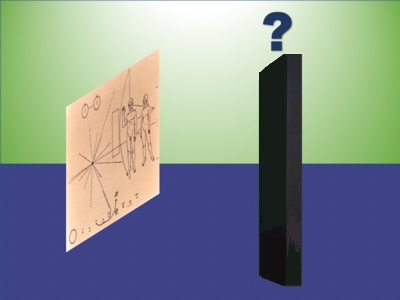
The best-known examples are the plaques on the Pioneer 10 and Pioneer 11 probes, and the golden records on the Voyager 1 and Voyager 2 probes. Apparently, the New Horizons probe did not have any message on it. I always thought that it was Carl Sagan’s idea, but read recently that someone else suggested it to him. Carl was a friend of Arthur C. Clarke, so may have known the story “History Lesson”.
The record does have a range of music and sounds, but I don’t think it is as representative as we might like. It has three pieces by Bach and two by Beethoven. I do not want to put them down, but there is so much other great music from cultures throughout the world they could have chosen. Besides, to give a proper idea of humanity, some more mediocre music would be worth including.
I read that the Voyager records will last at least a billion years. So, a billion years from now, one of the Voyager records may be the only evidence that humanity ever existed.
A recent example of deliberately leaving a message is https://www.theatlantic.com/technology/archive/2012/11/a-time-capsule-launched-into-space-for-aliens-to-find-when-all-the-humans-are-gone/265718/ I believe there are other proposals along these lines, but I wasn’t able to find them in a quick search.
Several times over the years I imagined a movie based on the concept. It would be difficult to make, since although we would know the context of the surviving piece of human culture, how could we imagine realistic extraterrestrials and how they would interpret the artifact.
Another approach would be to have humans find the last remaining artifact of an earlier civilization. Although, in that case, it would not be possible to show the discrepancy between the reality of the artifact and how it is interpreted.
The idea I came up with would be to focus on a conference of extraterrestrial scientists as they argue about the meaning of the artifact. At the end of the movie, they would watch that one surviving human video: the cookie monster making cookie soup.


This post is a mirror from my main blog http://www.dynamiclethargyfilms.ca/blog

Sunday, June 22, 2014

"Felix" and The Ancient Astronauts

The Red One
They say that reading is part of writing, so I think I can count some of my recent reading as work on "Felix". I've read a bunch of stuff about Lovecraft and ancient astronauts recently, which is something touched on in my story.

Pseudoscience

When I first learnt of Erich von Däniken’s "Chariots of the Gods", I was immediately convinced of it's veracity. However, as I read more, all of the claims disappeared in a puff of smoke. This lead to my interest in scepticism.

I have long since stopped reading the work of the people who perpetuate von Däniken’s ideas. These proponents haven't come up with any convincing evidence for their hypothesis. Nonetheless, I am still fascinated with the idea. In part, it is because the idea is, to me, plausible.

Recently I started to follow Jason Colavito blog about ancient astronauts and pseudo archaeology. See: http://www.jasoncolavito.com/blog. He takes a sceptical stance and investigates claims in some detail. One his major claims is that people who make claims about ancient astronauts were inspired by the stories of H. P. Lovecraft. He published the book "The Cult of Alien Gods" about his ideas. See: http://www.jasoncolavito.com/cult-of-alien-gods.html.

Jason Colavito links to Michael S. Heiser blogs. See: http://drmsh.com/ and http://michaelsheiser.com/PaleoBabble/. Heiser has debunked some ancient astronaut claims.

One of the disturbing aspects of many the ancient astronaut claims is their inherent racism. Although it doesn't often appear overtly, many of the arguments used boil down to "those people" were not capable of building something so impressive. Lovecraft often expressed racist views, which many of his modern day fans are uncomfortable with.

Science Fiction

Over the years I've come across many stories and movies that invoke the possibility of extraterrestrial visitors to Earth in the distant past. As noted above, H. P. Lovecraft's Cthulhu Mythos stories involve extraterrestrial visitors who have influenced history. He wrote most of these stories between 1926 and 1936.

Recently I came across an earlier story, Jack London's "The Red One", which was published in 1918. It concerns a man who finds an alien artefact deep in the interior of Guadalcanal. The descriptions of the natives in the story are quite racist, although it isn't clear to me if this reflects London's views or those of the character in the story. The story is available from Project Gutenberg. See: http://www.gutenberg.org/ebooks/788.

Several of Arthur C. Clarke stories have ancient alien visitations as a back ground. Most famous are the 1951 short story "The Sentinel" and the 1968 novel and movie "2001: A Space Odyssey". See: http://en.wikipedia.org/wiki/The_Sentinel_(short_story).

I hope to soon add my story "Felix" to this list.

Scientific Study

In the past, some scientists have taken the idea seriously. Most notable was Carl Sagan, who published papers on the subject in the early 1960s and later was involved with the SETI project. Since pseudoscience has taken over the ancient astronaut hypothesis, few scientists will take a serious look at the possibility. If you know of a serious scientific study of this, please let me know.


I remain intrigued by the idea of alien visitations in the past. For now it seems that it can only be explored in fiction. Some day some thing may show up to validate the hypothesis, but it does seem that not even the advocates have made any serious attempts to find that evidence.

I would like to explore this idea more in my stories and movies.

This post is a mirror from my main blog http://www.dynamiclethargyfilms.ca/blog

Sunday, April 6, 2014

"2001: A Space Odyssey" and H. P. Lovecraft

A couple weeks ago I posted "What is "2001: A Space Odyssey" About?" (http://dynamiclethargyfilms.ca/what-is-2001-a-space-odyssey-about/). In it, I mentioned in passing that I saw some similarities between it and the works of H. P. Lovecraft. Since then I've delved a little deeper into that idea.

Arthur C. Clarke and H. P. Lovecraft

I was reluctant to make too much of the possibility that Lovecraft's work dad an influence on "2001", because I didn't know if Clarke was familiar with Lovecraft. A quick search showed that he did.

In 1940, Clarke wrote "At the Mountains of Murkiness", a parody of Lovecraft's "At The Mountains of Madness". In "Icons of Horror and the Supernatural: An Encyclopedia of Our Worst Nightmares" S. T. Joshi mentions the story and notes that both "2001" and "Childhood's End" both share some ideas with Lovecraft's stories.

Lovecraft and "2001" Similarities and Differences

Lovecraft's basic idea is that extraterrestrials visited Earth far in the past and influenced the development of humans. The same idea underlies "2001".

Lovecraft suggests that these extraterrestrials were the inspiration for the gods that humanity worships. This is not suggested in the movie or book "2001", but Clarke does make the suggestion in his later novel "3001: The Final Odyssey".

A major difference between Lovecraft and Clarke is the attitude of the extraterrestrials. In Lovecraft they are at best indifferent to people and can be very antagonistic. Clarke sees the attitude of the  extraterrestrials as positive to people. In Clarke's earlier short story "The Sentinel", which was the basis for "2001", the attitude of the extraterrestrial is not so clearly positive. In "3001" the attitude of the extraterrestrials is also not necessarily kindly toward people.

Is it possible that maybe "2001" could be viewed as a Lovecraftian horror story? In the book Clarke does seem clear that the extraterrestrials are benign, but that might not be true of the movie. Like many of Lovecraft's heroes, at the end, Bowman appears to become overwhelmed by what is revealed to him. The scene in the "hotel room" could be just a figment of his imagination after he has lost his sanity.

Robert E. Howard and the Monolith

An interesting parallel to "2001" can be found in another Cthulhu Mythos story, "The Black Stone" by Robert E. Howard. In it the hero finds an ancient black monolith that was set up by ancient extraterrestrials. Although a different shape than the monolith in "2001" (octagonal) it is about the same height and depth.

"2001" and the Ancient Astronauts

In his book "Cult of Alien Gods" (http://www.jasoncolavito.com/cult-of-alien-gods.html), Jason Colavito makes the case that the ancient astronaut theory popularized by Erich von Däniken in his book Chariots of the Gods? was inspired by Lovecraft's stories. A review I read suggested that the case is weak, but it convinced me.

The ancient astronaut theory predates "2001", but I suspect that it could have played a role in the popularity of the ancient astronaut theory. In 1968, "2001" was a very high profile cultural event, and even people who did not go see it were aware of some of the ideas in the movie. Chariots of the Gods? was published the same year and was more broadly promoted by a TV program in 1970.

Because of "2001", the possibility of extraterrestrials visiting Earth in the past was an idea that was "in the air". This could have made people more open to the idea when von Däniken book was released. I know that this was a factor in my own interest in the theory. I was completely sold on the idea then, although eventually my interest led me to the skeptic movement.

What Can We Conclude?

I don't want to exaggerate the importance of the connections I found, but I think the comparisons do help me to understand "2001". Arthur C. Clarke said that the book he wrote was just his thoughts about what the movie was about.

I suspect that "2001" is more of a question than a statement. The explanations of the story suggested by comparisons with Lovecraft show that the "answer" to what "2001" is about is not straight forward. I think it is the stimulation we gain from the exploration that is important.

This post is a mirror from my main blog http://www.dynamiclethargyfilms.ca/blog

Sunday, March 23, 2014

What is "2001: A Space Odyssey" About?

The other day I watched a documentary about "2001" on YouTube. It has been my favourite movie for a long time and the documentary prompted me to re-explore what the film means.

The documentary I watched, "2001: A Space Odyssey - The Making Of A Myth", was made in 2001 by the BBC's Channel 4. In a series of interviews the documentary explores how they made the film, and what it meant. You can watch the documentary here: http://www.youtube.com/watch?v=GpoPhQNrpjE

However, they didn't talk about what I thought as an important aspect of the film: the parallel between the Monolith story and the HAL story.

Arthur C. Clarke often said that if you could understand "2001", then they had failed. The film is meant to provoke us to contemplate the nature of the Universe and our place in it. Nevertheless, I still feel we can find value when we try to find meaning in the film. At least in part, my interpretation is based on the book.

The Monolith Story and the HAL Story

As far as I can recall, when people talk about the HAL subplot, they don't relate it to main plot about the Monolith. I think that the two are related. Maybe people feel it is too obvious to mention. I'm not sure when I came to that view. It may have been a short time after I saw the film.

Initially, it seems that the subplot of HAL's rebellion and downfall are not related to the Monolith story. But, let's reconsider.

In the HAL story, HAL is a machine that people have created for their own purposes. As the story progresses, HAL develops behaviour beyond what the people who created it intended. When its behaviour threatens the existence of the people in its care, Bowman, the last survivor, has to shut HAL down. As he does so, HAL bit by bit regresses toward its infancy.

In the Monolith story, the Monolith is a representation of an advanced intelligence. The film does not say exactly what that intelligence is. In the first part of the film, the Monolith sparks the flame of intelligence in the pre-humans it finds on Earth. The pre-humans later develop into modern people, with great abilities, but also with a legacy of violence. In the last part of the film, Bowman, the people's representative, is transformed into the Starchild.

I think that the HAL story helps understand what happens to Bowman at the end. In the Monolith story, Bowman takes the role earlier played by HAL. The Monolith, like Bowman earlier, is disappointed with how people have turned out. While they may not be as big a threat to the Monolith as HAL was to Bowman, the Monolith acts in the same way as Bowman with HAL. The Monolith regresses Bowman back to his infancy. The difference is that the Monolith is far more advanced that people and so the Monolith is able to restart (reboot) Bowman. The film ends as a new beginning, with hope for the future.

"2001" and H. P. Lovecraft

While I worked on this post, I started to notice a parallel between "2001" and some of the stories of H. P. Lovecraft.

In many of his stories, for example "The Nameless City" and "The Mountains of Madness", Lovecraft's protagonists are driven to madness when they come to understand the vastness of the Universe.

Bowman can be seen as similar to the Lovecraftian protagonists in that his search to understand the Cosmos seems to drive him to insanity. I don't know if Clarke or Kubrick were that familiar with Lovecraft, or maybe it is just that I see something that isn't there.


Maybe other people can explore this idea further.

This post is a mirror from my main blog http://www.dynamiclethargyfilms.ca/blog

Sunday, August 5, 2012

Science Fiction Story Update 2012 August 5


I hadn’t planned to work on my science fiction story until later, but the ideas just poured out of my head this week. The story has a (tentative) title now: Heat Wave. I’m taking a slightly different approach to how I write this time. We’ll see how that goes.

Through out the week, I wrote my ideas, along with some dialog and description to use in the story in to my notebook. Later in the week, I started to work on the story itself. I decided that I should write the story in first person.

Most of my stories have been in third person because movie scripts are in third person. It wasn’t until this week that I realized that all scripts are in third person. I don’t think I’ve ever seen or heard anyone point that out. Even when you use a voice over to have a character describe how they feel and what they think, the script itself is still in third person.

About a month ago, I did an outline, but my concept of the story changed since then. I did a new outline. I gave the characters names and then I started to write parts of the story.

Normally I work from a general outline and write each scene in proper order. This time I decided I wouldn’t write them in any particular order. The main reason is that I have some very clear ideas about some scenes, including the final scene. For the other scenes I had only a vague idea what I wanted to do. As I finish scenes I expect to think about the other scenes, and that way build up into a complete story. So far, that approach seems to work.

I transferred what I’d written in my notebook with a voice recognition program. I think that sped up the process. I think the words flow easier when I speak them aloud. The voice recognition isn’t 100 per cent accurate, but I think I caught most of the problems. I got about 1,400 words of the first draft done so far.

I used Celtx for my story. It has some useful features. The “index cards” make it easier to move blocks of text around. Celtx was originally for movie scripts, but it does have a novel option. I used it on Bright Freedom and it was a big help there.

As I’ve thought about the story, I’ve started to realize that there are some parallels between the story and some of my personal experiences. I’ve altered the story a bit to take advantage of that. Recently I’ve read several books about H.P. Lovecraft. Despite his stories being weird fantasies, they point out where he has incorporated his personal experiences into his stories. Most authors do that to some extent, but it helped me see that I could use my experiences in this story.

The books I read were.
H.P. Lovecraft: Against the World Against Life by Michel Houellebecq,
Lovecraft: A Biography by Lyon Sprague De Campe, and
Lovecraft: A look Behind the Cthulhu Mythos by Lin Carter

I don’t plan to push ahead on this story. When I get ideas, I will follow them up. I had some more over the last few days, so I’ll likely do some more work on it this week.

Pierre Berton suggests that you read a good story before you write. I wasn’t sure what would be appropriate for my story. Yesterday I decided that I would read Earthlight by Arthur C. Clarke. I read the book back in high school, so my memory of it is a bit fuzzy, but I think it would be a good influence on my writing. In particular, the narrator is similar to how I see mine.

This post is a mirror from my main blog http://www.dynamiclethargyfilms.ca/blog